Showing posts with label sustainable buildings. Show all posts

Monday, 16 December 2013

What is the approximate cost of a green roof? How much energy does a green roof save?

  • What is the approximate cost of a green roof?

The cost of the green roof is depending on which state you are in, which would range from $10 to $25 per square foot or $108 - $269 per square meter... (one square meter = approximately 10.76 square feet). More sophisticated green roof (or green wall) installations can cost from $25 to $100 per square foot, or $269-$1075 per square meter or more.(source http://www.green-buildings.com/content/78335-green-roof-cost)

How much energy does a green roof save?

According to the Center for Climate Systems Research, a comparison of a standard black tar roof and a green roof showed these results:

One square meter of black tar roof produced 500 kWh per year. 
One square meter of green roof produced 140 kWh per year. (source http://alivestructures.com/FAQ/greenroof_faq)

On average, for one story structures, a green roof saves $4.50 per square foot on an annual basis.(source http://alivestructures.com/FAQ/greenroof_faq)


Sunday, 15 December 2013

The Research of The Green Roofs

Water consumption in our daily life


What Is The Green Roofs

What Is The Method of The Green Roofs

Why We Use The Green Roofs


What Kinds of Materials and Techniques Could use in The Sustainable Buildings

What Kinds of Materials and Techniques Could use in The Sustainable Buildings

Materials

Timber 

Cob

Fired Bricks

Concrete

Glass

Metal


Green Roofs

Insulation


Techniques-Renewable Energy

Ground source Heat Pumps

Photovoltaic Panels


Solar Thermal Hot-Water Panels


Why We Need The Sustainable Buildings?


  • Environmental benefits
  • - Enhance and protect biodiversity and ecosystems
  • - Improve air and water quality
  • - Reduce waste streams
  • - Conserve and restore natural resources

  • Economic benefits
  • - Reduce operating costs
  • - Create, expand, and shape markets for green product and services
  • - Improve occupant productivity
  • - Optimize life-cycle economic performance

  • Social benefits
  • - Enhance occupant comfort and health
  • - Heighten aesthetic qualities
  • - Minimize strain on local infrastructure
  • - Improve overall quality of life
  • Thursday, 12 December 2013

    Advantages & Disadvantages of The Green Roofs


    Advantages

    - Extended roof life: a green roof protects the waterproofing membrane from climatic extremes,   UV light and mechanical damage doubling its life expectancy.

    - Provides thermal insulation in the winter and helps to cool buildings in the summer.

    - Excellent sound insulation.

    - Growing mediums can be made from recycled materials, such as crushed bricks.

    - Reduces water run-off

    - Encourages biodiversity.

    - Provides attractive green spaces


    Disadvantages

    - Where the roof pitch is steeper than 40 degrees, a green roof is indefeasibly expensive. (cost http://lisantu2013.blogspot.co.uk/2013/12/what-is-approximate-cost-of-green-roof.html)

    - Plant growth is unpredictable because of airborne seeds and those dropped by passing        birds 


    Method of The Green Roofs


    Most domestic green roofs consist of a water proof underlay covered with soil or crushed stones and either topped with seed mats or planted with seeds. Sedum, a lo-growing succulent plant, is popular because it is resistant to wind, frost and drought and requires little maintenance, but a wide variety of plants can be grown as long as the building is strong enough to support the load. Using local substrates as the growing medium and panting local seeds will support local biodiversity, as will including such objects as dead wood to provide extra habitat for wildlife.

    Green Roof Layer


    How to build Green Roofs

    http://www.youtube.com/watch?v=xzTsFXB26GY

    Back to http://lisantu2013.blogspot.co.uk/2013/12/the-green-roofs.html

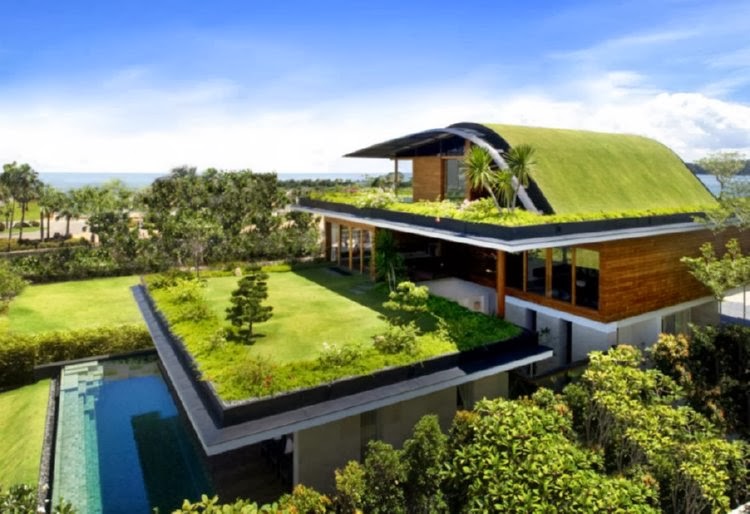
    GREEN ROOF


     source http://www.dezeen.com/2011/03/09/sky-garden-house-by-guz-architects/

    A green roof or living roof is a roof of a building that is partially or completely covered with vegetation and a growing medium, planted over a waterproofing membrane. It may also include additional layers such as a root barrier and drainage and irrigation systems. Container gardens on roofs, where plants are maintained in pots, are not generally considered to be true green roofs, although this is debated. Rooftop ponds are another form of green roofs which are used to treat greywater.(Source http://en.wikipedia.org/wiki/Green_roof)


    The other project from Singapore http://lisantu2013.blogspot.co.uk/2013/12/singapore-hotel-cover-with-plants.html 


    Sunday, 8 December 2013

    Singapore Hotel Cover With Plants


    This hotel is designed by WOHA on the edge of Singapore's Central Business District, which features large balconies and terraces covered in 15,000 square metres of tropical plants. Wong said that he wanted to create a hotel garden. Actually, the green areas in the building are larger than the site itself. I imagine that visitors who live in this hotel garden could not feel like they are live in business center. On the contrary, it seems that they have holiday at the place with wonderful garden view and sky terraces.


    All the inspiration comes from rock formations. He said "It's a very organic feeling that you get from the building."


    Thursday, 5 December 2013

    Sustainable System — Ground-Source Heat Pump

    Ground-source heat pumps extract latent heat from the ground via a borehole or net work of underground pipes. The heat is transferred to a mix of water and antifreeze carried in the pipes and then converted,through the heat pump, into thermal energy for heating hand hot water. Technically this is not renewable energy, as electricity is needed to power the pump, but that electricity amounts to one-third of the total energy produced, so the excess could be termed renewable. The pump can also be powered by solar energy or another renewable form.
     underground pipes

     use it for heating hand hot water
    For Example


    source : http://www.archdaily.com/352658/fox-house-pique-architecture/

    This home sits on a bluff overlooking rolling sagebrush meadows in Oregon’s High Desert with views of the Cascade Mountains dominating the western horizon. The request for a net zero house necessitated extensive use of photovoltaic panels, ground source heat-pumps, careful consideration of day lighting and shading strategies, and a super-insulated structure.

    Advantages

    - System is easy to maintain and lasts at least twenty years.
    - Lower running costs than oil, liquid petroleum gas, coal and electric heating     system.

    Disadvantages

    - The temperature generated - 50℃ is too low for a regular radiator to heat a room.        Heat pumps work better with underfloor heating, which can achieve room            temperatures of 25-28℃ from water temperatures of 45-65℃.
    - Can be installed only where the ground is suitably soft for digging a trench or borehole.
    - Higher running costs than mains gas heating.


    Monday, 18 November 2013

    HALO: Swedish Students’ Solar Decathlon Entry

    Resently, I have been studying sustainable house which can achieve use nature energy in order to save unnecessary waste. Then i found this project-Designed and built by 25 students from Chalemers University in Sweden, HALO is a socially sustainable home for four students, running on renewable energy from the sun. HALO was designed using one underlying concept: shared space is double space.
     
    The shape and name of HALO was inspired by the optical phenomenon that takes the form of a round shining circle around the sun. 


    The round shape of HALO’s structure provides maximum interior area while minimizing exterior perimeter, reducing heat loss potential. While the total area is low, and interior space only 60 m², the students are offered large common spaces and smaller private areas. 


    The roof is constructed of monocrystalline silicone photovoltaics laminated in thin acrylic plastic and coated with a high strength polymer. The cells were then applied to 10 mm thick double wall polycarbonate sheets which act as the waterproofing membrane for the roof. The solar panels are not just attached to the roof, they are the roof. Solar cells are often perceived as a limitation, due to strict module measures. HALO shows a potential for solar technologies to be truly integrated into the architectural design of a house. 

    Friday, 8 November 2013

    Green and Sustainable Buildings

    This is especially true today as society faces challenges of global warming, peak oil, and water scarcity. So " green " and "sustainable" are become the key words for modern architectures. How energy a building will save, how much less pollution it will produce,what sort of materials were chosen, and what affect on the health and comfort of the occupants is expected seems to be main questions that people care about. As following project, i mainly focus on green and sustainable house, which can achieve long-term use and save energy and realise environmentally friendly.

    There are two ways can achieve what i mentioned above. Generally, there are two ways could utilise solar energy in construction: one is passive solar, the other one is active solar energy. The so-called passive solar buildings are refer to the use of solar energy to provide indoor heating without other mechanical device to provide energy. The passive solar system is a process of transform nature source, which relys on conduction, convection and radiation heat to implement the collection, storage, distribution, and control of solar energy. On the contrary,the active solar buildings usually use of machinery to collection, storage, distribution to control solar heat.It needs two elements for passive solar system: one is to use the direction of transparent material (glass or plastic, etc.) or the dark materials to collect solar energy, the second is collection, storage and distribution of solar energy heat to receive maximal solar energy.